
A clear night — rendered, not photographed
Most forecasts give you an icon and a number and leave you to guess how much to trust it. We would rather answer the question you actually asked — can I see the sky tonight, when should I do this outside, what are the odds — and tell you how confident the answer is.
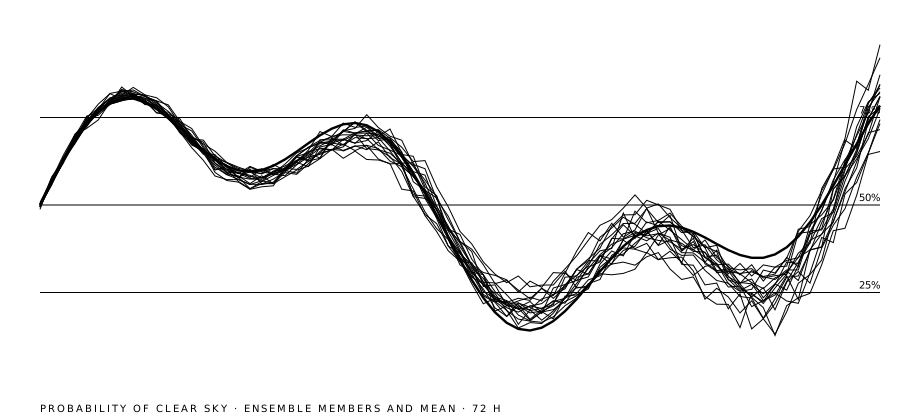
Forecasts are built from national numerical weather models and checked against live airport observations. Where the models disagree, we do not hide it — the spread between them is the confidence figure we hand back.
That is one question, not two, and Weather answers it as one. The Perseid peak over your roof, the cloud that will be sitting on it at that hour, and a confidence figure taken from how far the national models actually disagree with each other — in a single sentence, for your point rather than your region.
Chores turns the forecast into “do it now”. Beyond it, weather lives inside the other apps — the night worth going out for, the daylight your clock will actually get.
The apps → WeatherTemperature, rain and wind for the next 48 hours, right where you are.
 ChoresThe forecast, rewritten as do it now.
A forecast is out of date before the ink dries, so Weather arrives in the forms that stay current: a number in the app, a window in the planner’s day, an alarm that fires when the cloud actually clears, a line in your calendar the evening before. The climate normals behind it — the average sky for this place in this month — do print, and they sit in the almanacs.
Forthcoming
Point forecasts and quantities, the odds of a condition rather than a yes/no, working windows, pressure trend, live observations — and a confidence figure that comes from how far the models actually disagree. Ask for tonight’s sky, a working window, an hourly forecast, or the confidence behind any of it, for any place.
Want it wired into the system that actually makes the call — a dispatcher, a booking page, a site diary — or built into software of your own? Ask for that instead. And if you have looked at this and concluded it could not be done, bring it here and let us give it a second thought.
Tell us what you are building API, integrations and bespoke software →