
Dawn, rendered — the light that sets the clock
Nineteen windows in your day, computed from the light you actually get where you are — when to sit in the light, when the last coffee is, when to sleep, and when to take care.
Each window is a number with the model it came from named. Four groups: the clock itself, sleep and alertness, sun and the seasons, travel and work — and one contested window, shown with both sides on the table.
A sample day — not yours. Yours is computed from your latitude and the date, which is the whole point: the curve moves, and the windows move with it.
One of the nineteen, free and working. It depends on your body clock, not on the hour on the wall.
Body follows all nineteen windows through your day, wherever you wake up. Flow is a cycle tracker that states its uncertainty instead of faking a date. Both read the light your place actually gets, so the windows move when you do.
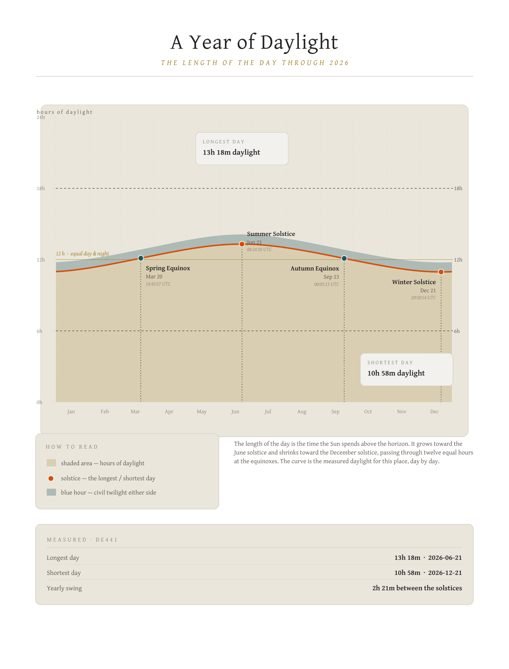
The apps →The body clock is printed to the case in front of it, not to a rack of fixed titles. Name the route and we set a jet-lag plan for it; name the ward or the crew and we set the rotation; name a latitude and we set the year in light. Each is computed for those exact people in that exact place, then typeset and delivered print-ready.
The full set of body-clock windows against the real sun at your caller’s latitude: sleep and wake, caffeine, light-shift, melatonin timing, alertness peaks, UV dose and vitamin D, jet lag and shift strain. Each returned as a number, with the published model it came from named alongside it.
Want it wired into a rota, a scheduler or an app you already run, or built into software of your own? Ask for that instead. And if you have looked at this and concluded it could not be done, bring it here and let us give it a second thought.
Tell us what you are building API, integrations and bespoke software →
The Body app is coming. Leave your email and we’ll tell you the moment your nineteen windows go live — nothing else.
Never shared. Unsubscribe anytime.